

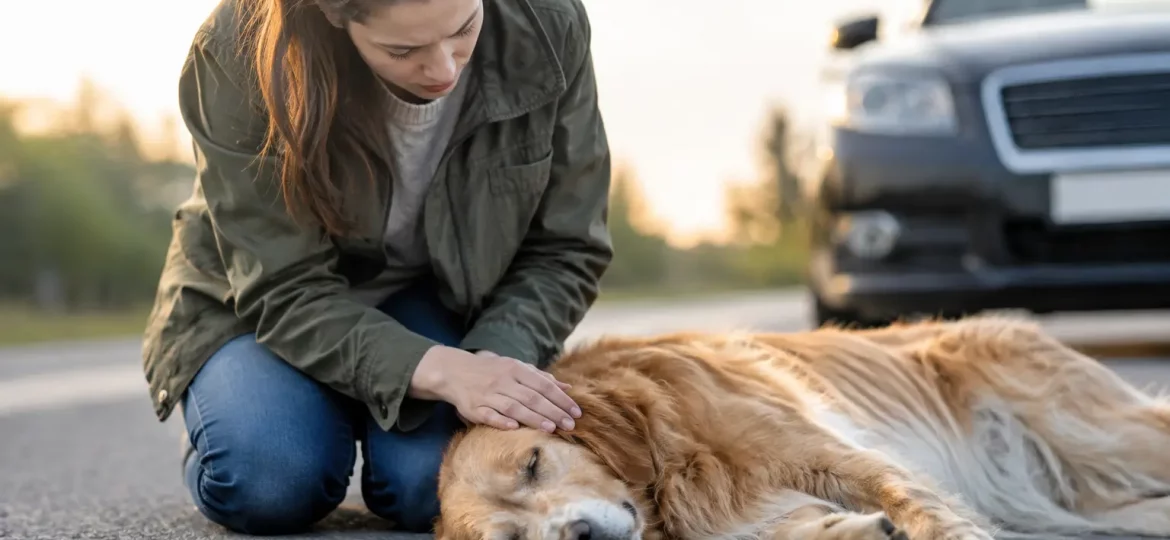
A road accident happens in seconds, but the first few minutes can greatly influence the care your animal receives. Knowing what to do after your pet is hit by a car helps you protect it without putting yourself in danger, reduce stress and give the vet information that may be decisive for the diagnosis.
Even if your dog or cat gets up and seems to walk normally, do not consider the incident closed. Some internal injuries, bleeding or organ damage are not visible to the naked eye and can worsen over the following hours. The general rule is clear: after an impact with a vehicle, your pet needs veterinary assessment as soon as possible.
What to do after your pet is hit by a car, step by step
1. Stop the vehicle in a safe place
If you have hit your own pet or witnessed the accident, the first thing is to avoid a second dangerous situation. Turn on the hazard lights, stop only when you can do so safely and check the traffic before approaching the animal.
Do not step into the road or run towards it if cars are moving. If the animal is on a fast road, visibility is poor or there is immediate risk to people, call the emergency number. The priority is that no one else gets hurt.
2. Approach calmly and avoid sudden movements
Pain and fear can make even a normally calm animal try to escape, scratch or bite. Speak to it in a low voice, avoid surrounding it with several people and do not put your face close to its muzzle.
If it can walk, prevent it from heading towards the road, but do not force it to move. A limping dog or a hiding cat could have a fracture, a spinal injury or trauma that should not be made worse. If you have a lead, use it gently and only if it does not hinder its breathing or posture.
3. Check its condition without handling it too much
Observe its breathing, level of consciousness and any visible bleeding. Very pale gums, rapid or laboured breathing, extreme weakness, a swollen abdomen, seizures, disorientation or an inability to stand are signs of an emergency.
If there is a bleeding wound, press gently with gauze or a clean cloth. Do not apply alcohol, hydrogen peroxide, creams or disinfectants without veterinary guidance. Nor should you try to reposition a leg, remove an embedded object or clean a deep wound: these actions can increase pain and bleeding.
4. Do not give it food, water or medication
It is understandable to want to relieve it immediately, but do not give human medicines. Common drugs such as ibuprofen, paracetamol or aspirin can be dangerous for dogs and cats, even in small doses.
Nor should you offer food or water until you have spoken to the vet. Your pet may need sedation, anaesthesia, diagnostic tests or surgery, and prior intake can complicate care. The exception would be a specific instruction given by a professional who already knows the case.
5. Move it with support and without forcing its posture
How you move it depends on its size and condition. For a small animal, use a rigid carrier if possible, or a stable box padded with a towel. For a medium or large dog, a blanket, a flat board or a firm surface can serve as an improvised stretcher between two people.
Try to keep the body as straight and stable as possible, especially if it cannot get up, is in intense pain or you suspect a back injury. Cover it lightly if it is cold, without covering its face or hindering its breathing. During the journey, one person should watch for changes in behaviour and keep the environment calm.
6. Call a veterinary clinic before you arrive
Let them know it is a road accident and briefly explain when it happened, whether the animal lost consciousness, whether it is bleeding and what symptoms you have observed. This way the clinic can prepare for the care and advise you on the transfer.
Even if the impact seemed minor, it is advisable to request an examination the same day. The vet can assess pain, fractures, neurological injuries, respiratory status and possible internal damage through whatever tests they consider necessary. Not every road accident requires hospitalisation, but only a professional check-up can decide that safely.
7. Keep the useful information about the incident
Once the animal has been treated, note the time and place of the accident, how it happened, the initial symptoms and any change you saw. If another vehicle was involved, collect its details and, when it is safe to do so, take photographs of the surroundings and the visible damage.
These details can help the vet understand the intensity and direction of the impact. They may also be necessary if there is a liability claim or if you need to process veterinary expenses with your insurance. Keep the itemised invoice, the clinical report, the tests carried out and the prescriptions. With reimbursement pet insurance, such as the policies offered by Petplan, this documentation is usually essential to manage the claim online.
If the pet seems fine, do you still need to go to the vet?
Yes, it is advisable. The absence of blood or limping does not rule out an injury. Animals tend to hide pain, and adrenaline can make them seem active for a while. A blow to the chest, abdomen or head can cause problems that show up later.
After the consultation, follow the instructions you receive and pay particular attention during the first 24 to 48 hours. Go back or contact an emergency service if there is lethargy, vomiting, excessive panting, difficulty breathing, unequal pupils, stiffness, crying when touched, loss of appetite or changes in urination and defecation.
If you have found a pet that has been hit
When the animal is not yours, act with the same caution. If it has an ID tag and you can do so without delaying care, note the contact number or call its family. If there is no identification, the veterinary clinic can check whether it has a microchip.
Do not assume it has been abandoned or that someone else will take care of it. If you cannot move it safely, contact the local police, the relevant municipal service or an animal rescue organisation in your area. Give the exact location, the animal’s apparent condition and the danger on the road.
Being prepared is also part of caring
You cannot foresee an accident, but you can reduce improvisation. Using a lead in traffic areas, checking that the microchip and contact details are up to date, getting your cat used to the carrier and saving the phone number of an emergency clinic are simple measures that save time when every minute counts.
It is also worth knowing in advance how your pet insurance works and what documents you will need to submit if you have to request a reimbursement. Having that part sorted does not remove the worry, but it lets you focus on what matters: that your pet receives prompt, appropriate care with as little stress as possible.
