


Fleas and ticks feed on your pet’s blood and, far more seriously, transmit disease. They can cause anaemia, allergic dermatitis and zoonoses that pass to people. Never pull a tick off with your bare hands: use gloves or proper tweezers. Prevention — spot-ons, collars or tablets — is needed all year round, not just in summer.
Key facts:
- What they do: feed on blood and transmit disease.
- Risks: anaemia, flea-bite allergic dermatitis, and zoonoses that affect people.
- Ticks: never pull them off by hand — use gloves or fine tweezers.
- Prevention: spot-on pipettes, collars or tablets, as your vet advises.
- Routine: check your pet after every walk, especially ears, neck, armpits and between the toes.
- Risk period: all year, not only in summer.
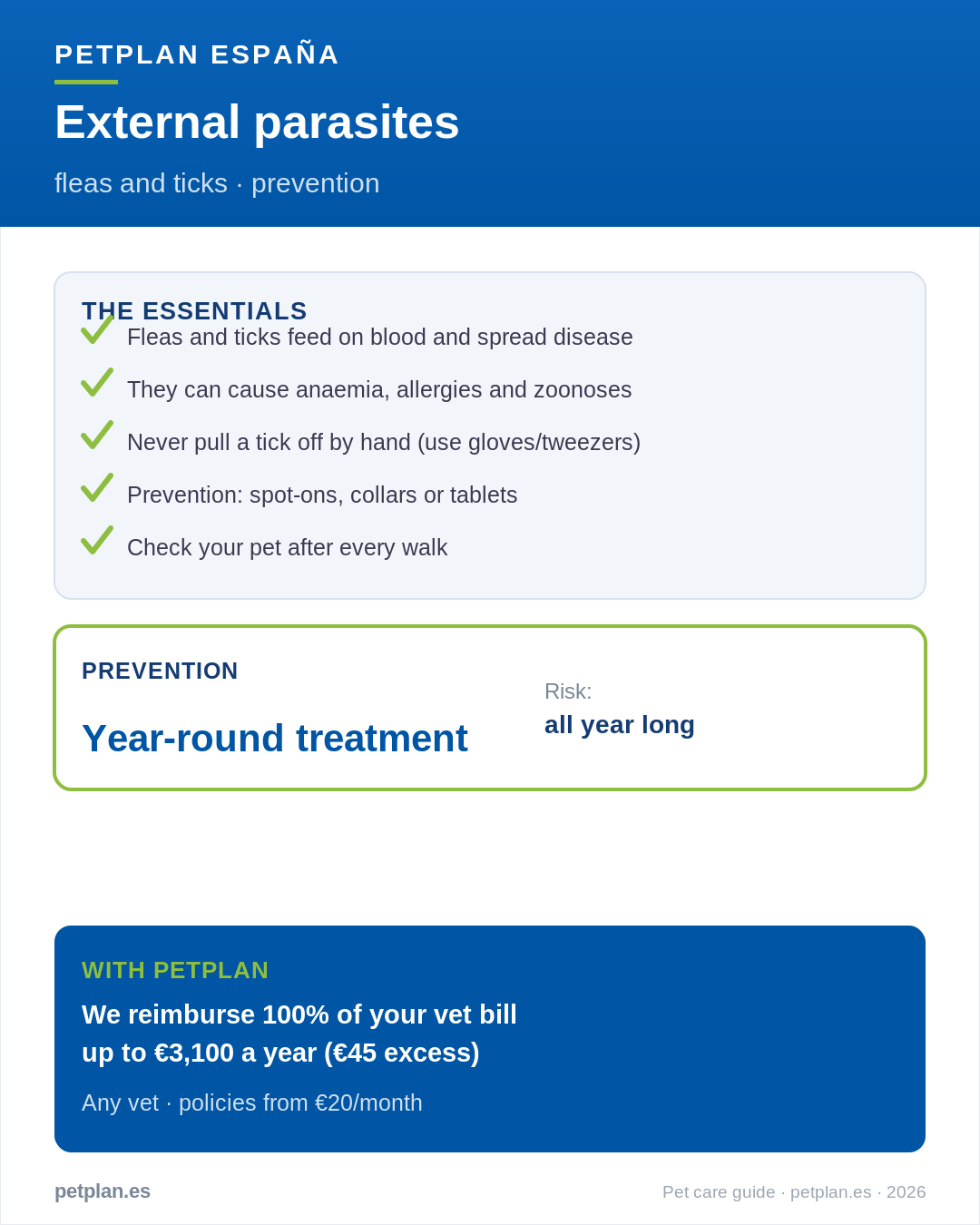
A flea is not just an itch, and a tick is not just a lump. Both are vectors: what they carry is usually worse than what they do themselves.
Why are fleas and ticks dangerous?
Both are external parasites that live on the animal and feed on its blood. In a heavy infestation, particularly in a puppy, kitten or small pet, that blood loss alone can cause anaemia. But the real danger is what they transmit: ticks carry serious infectious diseases, and fleas can transmit tapeworm. Some of these are zoonoses, meaning they can affect the humans in the household too.
What is flea-bite allergic dermatitis?
It is the commonest allergy in dogs and cats, and it is worth understanding because it changes how you think about fleas. In an allergic animal, a single bite is enough to set off intense itching that lasts for days. So “I only saw one flea” is no reassurance at all: the reaction is to the flea’s saliva, not to the number of fleas.
How do I remove a tick correctly?
Never pull it off with your bare fingers. Use gloves or proper fine tweezers, grip the tick as close to the skin as possible and pull steadily, without twisting or crushing it. Crushing the tick, or squeezing its body, can push infected material into the animal — which is exactly what you are trying to avoid. Do not use petrol, alcohol or a lit match; those old tricks make the tick regurgitate. If you are unsure, let your vet do it.
How do I prevent them?
With a proper antiparasitic product: spot-on pipettes, repellent collars or oral tablets. Which one suits your pet depends on its species, weight, lifestyle and where you live — your vet will recommend the right product and the right interval, and it matters that you respect that interval, because protection lapses when the product wears off.
When is the risk highest?
Fleas and ticks are most active in the warm months, but with milder winters the risk now extends through the whole year in much of Spain. Treating only in summer leaves a long window open. Get into the habit of checking your pet after every walk — run your hands over the ears, neck, armpits, groin and between the toes, which is where ticks like to attach.
Frequently asked questions
Can fleas and ticks affect people?
Yes. Some of the diseases they transmit are zoonoses, meaning they can pass to humans.
How do I remove a tick from my dog?
With gloves or fine tweezers, gripping close to the skin and pulling steadily. Never crush it or use petrol or a flame.
My dog only had one flea — why is it so itchy?
In flea-bite allergic dermatitis, a single bite triggers days of intense itching.
Do I need to treat in winter?
Yes. With milder winters the risk now runs all year round in much of Spain.
A parasite-borne illness means tests, treatment and follow-up. Petplan España (Petplan Ibérica, S.L.) reimburses 100% of the vet bill up to €3,100 a year, with a €45 excess, at any vet you choose. See the policy terms.
