


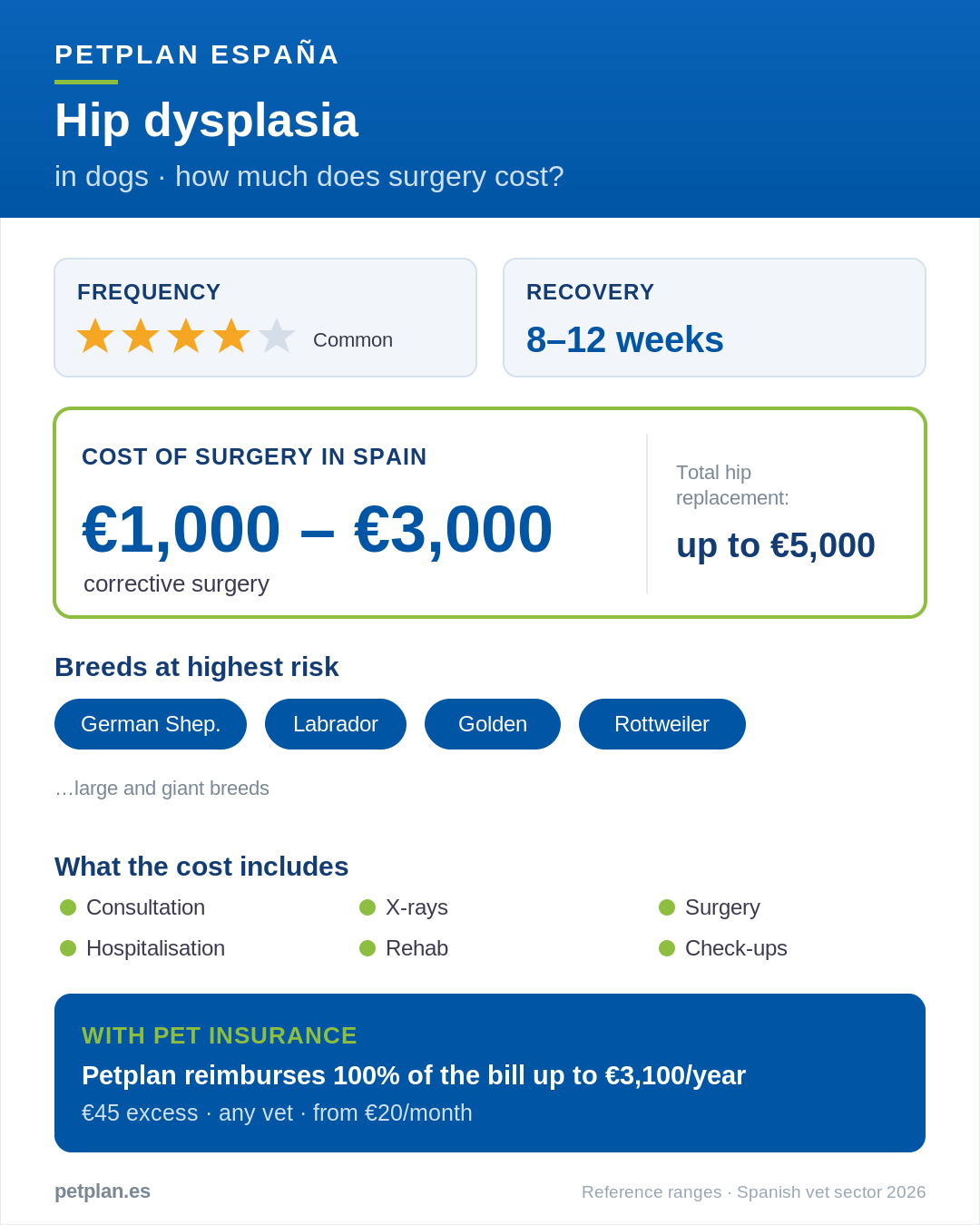
Operating on hip dysplasia in a dog in Spain costs €1,000–€3,000 for corrective surgery, and €2,500–€5,000 per hip if a total hip replacement is needed (2026). Petplan España (Petplan Ibérica, S.L.) reimburses 100% of that vet bill up to €3,100 a year, with a €45 excess.
Key facts:
- Corrective surgery: €1,000 – €3,000.
- Total hip replacement (per hip): €2,500 – €5,000.
- Frequency: common in large and giant breeds.
- Breeds most at risk: German Shepherd, Labrador, Golden Retriever, Rottweiler and St Bernard.
- Recovery: 8 to 12 weeks, with rehabilitation.
- Petplan cover: 100% up to €3,100/year, €45 excess, any vet, from €20/month.
Hip dysplasia is one of the most common orthopaedic conditions in large dogs. The hip joint doesn’t fit together properly, wears out early and causes pain, lameness and arthritis. It is largely hereditary, but weight and exercise also play a part, and its treatment can be one of the most expensive.
This article explains what it is, which breeds are most exposed, how much surgery costs in Spain, and how pet insurance helps you face it.
What is hip dysplasia?
Hip dysplasia is an abnormal development of the joint: the head of the femur doesn’t sit correctly in the hip socket. That poor fit causes friction, inflammation and, over time, arthritis. The signs —difficulty getting up, lameness, reluctance to climb stairs or jump— often appear from a young age or worsen with age. Treatment ranges from medical management and physiotherapy to surgery, which in advanced cases can mean a total hip replacement.
Which breeds are most at risk?
It mainly affects large and giant breeds. The most predisposed include the German Shepherd, Labrador Retriever, Golden Retriever, Rottweiler and St Bernard. It is largely hereditary, so it’s worth knowing the parents’ background. Keeping a healthy weight from puppyhood and avoiding high-impact exercise during growth help reduce the risk and severity.
How much does hip dysplasia surgery cost for a dog in Spain?
Operating on hip dysplasia in a dog in Spain costs €1,000–€3,000 for corrective surgery in 2026; if a total hip replacement is needed, the cost rises to €2,500–€5,000 per hip. Here are the reference ranges:
| Treatment | Reference cost |
|---|---|
| Corrective surgery | €1,000 – €3,000 |
| Total hip replacement (per hip) | €2,500 – €5,000 |
| Consultation and X-rays | depending on clinic |
The cost depends on the technique, the size of the dog and whether one or both hips are affected. The rehabilitation afterwards, important for recovering mobility, also adds up. Veterinary fees in Spain are not regulated, so they vary between clinics and cities.
What does the price of the operation include?
It’s worth looking at the whole picture: the consultation, X-rays (sometimes under sedation), pre-anaesthetic blood work, anaesthesia, the surgery or prosthesis, hospitalisation, pain medication and rehabilitation. When asking for a quote, check what’s included and whether the price is for one hip or both.
Does pet insurance cover hip dysplasia?
Yes, with one important caveat: as a condition with a hereditary basis, it’s essential to take out insurance while the dog is healthy, since pre-existing conditions are excluded. Taken out in time, Petplan España reimburses 100% of the vet bill up to €3,100 per year, with a €45 excess, including physiotherapy. A replacement can exceed the annual limit, in which case cover applies up to the maximum —still an enormous relief.
The model is simple: you take your dog to the orthopaedic vet of your choice, pay the bill and claim the reimbursement under the terms of your policy. Petplan policies start from around €20 a month. The full list of cover and exclusions is set out in the policy terms.
Frequently asked questions
How much does hip dysplasia surgery cost for a dog?
Between €1,000 and €3,000 for corrective surgery; a total hip replacement costs €2,500–€5,000 per hip.
Which breeds are most at risk of hip dysplasia?
Large and giant breeds: German Shepherd, Labrador, Golden Retriever, Rottweiler and St Bernard.
Does pet insurance cover hip dysplasia?
Petplan reimburses 100% of treatment up to €3,100 per year (with a €45 excess), including physiotherapy, as long as it is not a pre-existing condition. Check the policy terms.
How long does a dog take to recover?
The usual recovery is 8 to 12 weeks, with progressive rehabilitation.
Methodology: reference cost ranges compiled from public sources in the Spanish veterinary sector (2026). Prices vary by clinic, city, dog size and severity of the case.
